Friend me on Netflix

Sunday, April 12, 2009


Observe and Report (Dir: Jody Hill)

With "Observe and Report," director Jody Hill continues to create ballads to the emasculated and crazy. "The Foot Fist Way," Hill's choppy first effort, followed constantly cuckolded Tae Kwan Do instructor Fred Simmons (Danny McBride) and his delusional reach for greatness. "Eastbound and Down," Hill's recent HBO series, tells the story of the John Rocker-like Kenny Powers (Danny McBride) and his delusional quest to re-enter the majors well past his prime. "Observe and Report," featuring a cameo by Danny McBride, cranks up the violence and delusions and plays unlike any other recent comedy, excepting those from Jody Hill.

There is constant cruelty in Hill's work and the climaxes reach a fever pitch where extreme violence redeems the hero. Hill continuously humiliates his male leads who are oblivious to their incompetence and then redeems them through the exercising of their own worst natures fueled by their once pitiable craziness. He seems to always be having it both ways, destroying with cruelty giving the audience the laughs that come from superiority, but closes by giving them a hero to leave them happy. The world that pitied and laughed at the violent failures inevitably bends to their will and eventually honors them. You don't need medication. Just your dreams.

Adam Sandler, Rob Schneider, and Jerry Lewis comedies tend to function this way as well, but Hill's view of the world is so much uglier and harsh making the laughs more bitter and the conclusions more confounding. ("Eastbound and Down" was more successfully realized, however, in its final moments, but the next to the last episode offers a weird, violent scene of redemption.) Hill does surround himself with talented casts and does successfully strip his actors down to the worst they can be, but to what end?

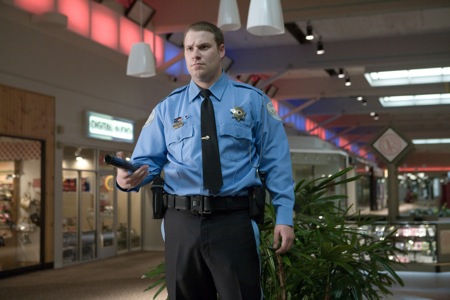
I liked "Observe and Report" to a point--Seth Rogen is compelling as a mall cop who mistakes life for a Michael Bay film and Anna Farris continues to shine no matter what material she's given--but its tone shifts are too sudden and false to allow the movie to resonate beyond its moment-to-moment shock comedy. The film will startle laughter, sympathy, and revulsion out of you, but for what? The film totally blows it in its uplifting final moments, but maybe by that point we're living in the fevered imagination of mall cop Ronnie Barnhardt. The movie shocked, but left me shrugging.

Monday, March 16, 2009


Synecdoche, New York (Dir: Charlie Kaufman)

Navel gazing. Self-indulgent. One is tempted to level both criticisms at Charlie Kaufman's directorial debut. But the film doesn't end its gaze at the navel--it keeps burrowing in deeper, past the lint, through the dermis, and into the bowels of the writer/director. And faulting him for self-indulgence is redundant since the film is clearly a journey into the fevered psyche of Kaufman where we are asked to sort out the details. We are invited to Be John Malko--I mean Charlie Kaufman. We have been let off at the 7 1/2th floor and entered the Kaufman door.

Kaufman, of course, scripted "Being John Malkovich" and with "Synecdoche" he revisits some of the same ontological and phenomenological territory. What is the self? How do I perceive myself, others, and the universe? "Malkovich," however, was buoyant, playful, and wacky and closed with a hopeful coda while "Synecdoche" makes a beeline straight for the pain. We will wallow in it with playwright Caden Cotard (Philip Seymour Hoffman), Kaufman's doppleganger, and live through a lifetime of regret in two hours. The different tones of the two films has to do in part with directors. Spike Jonze brought a light, inventive touch while Kaufman is just as content to let images sit still for contemplation. Even the visual inventiveness, and this film is not in short supply, does not pop and delight. It causes dread and unease.

But this is surely the point. The film begins in a relatively straightforward manner. Cotard is depressed and having difficulties in his marriage to Adele (Catherine Keener). He is anxious about his staging of "Death of a Salesman" and has begun a flirtation with the theater's ticket seller (Emily Mortimer). The film appears to be a normal domestic drama, but as the minutes pass we know something is slightly off. By the time we visit the house that's always on fire, the film has become completely unmoored from reality as we know it and we have to begun to experience the director's existential dread right alongside of him.

The film is endlessly creative but too self-involved to stir most audiences. As with Woody Allen, Kaufman's films appear to be therapy where he works out his issues and neuroses on screen. It has been said that you are everyone in your dreams and Kaufman teases this out in his films to the point where you are also everyone in your waking life and a god as well. It's a solipsistic existence that's finally intensely lonely. The commercial prospects for this were clearly limited. Kaufman breaks free of typical narrative convention and lets his ideas take the lead.

"Synecdoche" is filled with ideas and strong female performers. Catherine Keener, Dianne Weist, Emily Watson, Jennifer Jason Leigh, Samantha Morton, Hope Davis, and Michelle Williams all give fascinating performances. It's exciting to see so many accomplished actresses in challenging roles all in one film. The film follows no predictable pattern and continually surprises. It's a fully realized depiction of dread and longing, but not completely convincing in its convictions.

Monday, March 9, 2009


Watchmen (Dir: Zack Snyder)

Some of "Watchmen" is brilliant. Set in 1985 in a world where Richard Nixon was elected to multiple terms and men and women with super powers helped us win the Vietnam War, the US is on the brink of nuclear war with the Soviets. Those with super powers have not made the world better--we see this in "The Dark Knight" as well--and, in fact, have helped make it worse. In this plot point we see an argument against the still going weapons race--it leads to escalation, increased danger instead of safety--played out onscreen. The development and eventual weaponizing of the the super powerful Dr. Manahattan, able to reconstitute matter at will, raises tensions with the Soviets leading us to the brink of annihilation.

This is the game and stakes as "Watchmen" opens. A costumed hero will be murdered sending the Travis Bickle-like Rorschach into action as he sets out to solve the mystery. Rorshcach sees the world in black and white--mostly black--and he the avenging angel giving no quarter to the "scum" of the city. His investigation leads him to interview other costumed heroes and in this way we witness a host of origin stories and learn the dark secrets of many of the superpowered. Unfortunately, the film telegraphs its villain a little too clearly so then we are only left with trying to discern motive.

Snyder's theme, by way of the Alan Moore novel, seems to be that the superpowered are not heroes and so much ability consolidated into only a few individuals is good for none and leads to the emergence of a fascist class. Snyder seems to be be bringing this theme to the fore as he shows heroes mangle the bodies of the unjust. They burst limbs open and hack into villains with seeming ease and glee. The scenes are repulsive and I'm willing to go along with the director if the harrowing violence is meant to show how depraved these heroes actually are. It's an invigorating, if not pleasant, reimagining of the super hero genre.

But then Snyder tips his hand and it becomes clear that the bloodbath and wallowing in the gore is, as in the ridiculous "300," meant to be violent ballet. And it's not so much the violence that bothers me--I loved Snyder's unsentimental "Dawn of the Dead" remake--but how its inclusion lays waste to all the nuance that has come before. This fact crystallizes in a prison scene where Rorschach, the Silk Spectre, and Nite Owl escape from a prison riot and are clearly having fun as they hack off limbs with power saws and beat enemies to a pulp. The movie then tries to return to profundity, but it is now clear that Snyder's slo-mo, bone crunching is the point of the film. The Moore novel provides Snyder a pretext for heroes beating the snot out of their inferiors.

There is brilliance in the film, however. The opening credit sequence is a wonder as it lays out a dense backstory in just a few minutes. It reminded of DeVito's incendiary opening monologue in "L.A. Confidential." The set decoration and costuming bring the world of the classic novel to life and this is sure to please its most ardent fans. Jackie Earle Haley, unsettling in "Little Children," nails Rorschach and Billy Crudup as the god-man Dr. Manhattan is sufficiently cold and distant. Dr. Manhattan's transformation from man to weapon is tragic and the movie's high point.

So much works in the film, but its stylized violence undercuts its themes. A fascinating misfire not for the squeamish.

Tuesday, March 3, 2009


Coraline (Dir: Henry Selick)

"Coraline," is a fantastic mix of the traditional and the cutting edge. Utilizing beautiful stop motion animation and presented in 3D, in some theaters, the film offers a time-honored message in a state of the art package. 3D has advanced to the point where it actually serves the story as opposed to being an end unto itself. In the opening credit sequence, we see long, spindly iron fingers above the screen as they construct a button-eyed doll. There is menace in these metallic hands and the three dimensional effect adds to the sense of dread. The hands seem close and capable of reaching out to us. When the characters onscreen stand outside a doorway, the viewers are tempted to lean forward in order to peak into the room. The 3D is effective and enriching.

Coraline (Dakota Fanning), the pre-teen heroine of the film, is moving into an apartment complex in the filled with eccentric neighbors. Her parents both write and leave Coraline feeling alone and neglected. She hates her dad's cooking and misses her old friends. And then she finds a mysterious door in the wall and while playing one evening chases a little mouse through the door and into a mirror universe that looks similar to her own, but seems better. The food is better, the world never boring, and her button-eyed Other Mother and Father give her everything she wants.

The film, based on an excellent novel for children by Neil Gaiman, has a strong message at its heart. "Coraline" posits that hedonism is both empty and dangerous. Also, in order to fully indulge you must become blind to the suffering your pursuits will cause. It's a bit surprising that in a package as cutting edge and fantastic as "Coraline" that we are essentially being presented with a traditional moral warning. The film is not heavy handed, however, and your pre-teens will not quickly pick up on the message. In the context of the film, the message is completely sensible.

The animation on display is excellent, but as the movie showcases its character design and animation set pieces the story loses some momentum. Once Coraline discovers her quest, however, the movie becomes engrossing and tense. In fact, the film's extended climax will likely be too intense for the very young. The voice work is delightful with Terri Hatcher surprising in two roles as Coraline's mother and the film's villain. She is obviously enjoying the role and it enriches the entire experience. Also listen for a cameo by John Linnell of "They Might Be Giants."

The artistry on display is delightful and the film offers a unique animated experience. Go see this one soon, but leave those under five at home.

Monday, March 2, 2009


Fireproof (Dir: Alex Kendrick)

Earnest and well-meaning, "Fireproof" is, nonetheless, not very good. The film is crippled by tepid direction, amateur theater level acting, and a proselytizing endgame. It is important to note, however, that the film was made entirely by volunteers. This does not improve the quality of the movie, but it perhaps helps us to be more forgiving of its flaws. We don't expect The Mercury Theater when we attend the local church's drama night. It's a religious tract on film and by church drama standards, it's "Citizen Kane."

Fireman Caleb Holt (Kirk Cameron) supervises his fire station in a tough, but fair manner. He has earned his co-workers respect, but feels totally disrespected at home by wife Catherine (Erin Bethea). Their marriage is in trouble as their home life has devolved into daily recriminations and petty squabbles. Catherine has also caught the eye of a doctor (Walter Burnett) and the two appear destined for a fling. Caleb's dad, fearing his son's marriage will soon end, presents him with a handwritten book called "The Love Dare" that challenges Caleb to begin acting kindly and selflessly toward his wife.

Caleb never comes across as very sympathetic and this is both, I believe, a function of the script and a sign of Cameron's limited acting ability. He fully commits to anger and frustration and holds that note until a transformation late in the third act. (This is hardly a spoiler if one is aware of the necessities of the genre.) What's problematic is that both his transformation and the hope of reconciliation rest on his returning to the church. Fair enough given what is obviously the film's goal--winning converts--but that this path is the only way to save a troubled marriage is a bit of cop-out. What hope do folks have who are either in church and struggling in their marriages, or do not attend church and have no intention of doing so? The film implies that acting unselfishly--a key to sustaining marriage--cannot occur unless one is a Christian. That's simply not true and immediately limits the effectiveness of the film, if it is, as I believe it wants to be, a tool to save marriages.

And of course the very fact that the film is a tool first and a drama second hinders it from the starting gate. The drama and characters are always on message and so everything's a little too tidy and the marriage difficulties a little too neat and chaste. The directorial choices, particularly lighting and composition, are also safe and workmanlike, sanitizing every moment. The movie's just too safe to create any needed sense of peril. Surprisingly, though, given the film's limited budget, it's two action scenes, while clearly staged, give the film a pulse and generate the movie's only heat. One stunt, involving a train bearing down on the heroes, looked genuinely dangerous.

Too tidy and on message to move any but the converted.

Saturday, February 21, 2009

Awards Week: Oscar Preview


The 81st Academy Awards celebration will commence tomorrow night and this year there's little to get excited about. The Best Picture nominees are largely middling--"Milk" was filled with great performances and "The Curious Case of Benjamin Button" was close to excellent. But "Slumdog" was all flash and no depth, "Frost/Nixon" was an entertaining trifle, and "The Reader" is an embarrassment to the Academy. It's not a horrible movie. It's just not any good. How many other films were deserving of thesel five spots? I can name you at least ten.

It was selected because its producer Harvey Weinstein is a master of getting films nominated. Its selection lays bare the vacuity of the Awards. The game is close to fixed. Like politics, Oscars are given to those who are able to throw enough money into the campaign. And the films are furiously campaigned for. Pick up a copy of Variety any time in the Winter and you'll see. Those full page ads are expensive.

The selections are almost always safe and predictable as well. (Those film goers wanting to consult the Academy for some of the year's most interesting films should look to the Best Original Screenplay category--the ghetto to where the year's more edgy, engaging films are usually relegated.) The best way to approach the awards is to see them as an expensive pageant put on by the studios to help boost ticket and DVD sales. Winning an award brings some prestige to the studios, but more importantly they help make them money. Hense the expensive campaigning.

Best not to get too upset if your favorite films don't win any awards, or aren't even nominated. The Academy Awards are to quality as winning the Pro Bowl is to gridiron glory.

With all those caveats, here's my quick run through the major nominees (see full list here):

Performance by an actor in a leading role

* Richard Jenkins in "The Visitor" (Overture Films)
* Frank Langella in "Frost/Nixon" (Universal)
* Sean Penn in "Milk" (Focus Features)
* Brad Pitt in "The Curious Case of Benjamin Button" (Paramount and Warner Bros.)
* Mickey Rourke in "The Wrestler" (Fox Searchlight)

Seems like it's Rourke's to lose. Academy voters like a good story and the story of a performer trying to resurrect his career dovetails nicely with Rourke's comeback story in the making. Consider Penn a strong second place.

Performance by an actor in a supporting role

* Josh Brolin in "Milk" (Focus Features)
* Robert Downey Jr. in "Tropic Thunder" (DreamWorks, Distributed by DreamWorks/Paramount)
* Philip Seymour Hoffman in "Doubt" (Miramax)
* Heath Ledger in "The Dark Knight" (Warner Bros.)
* Michael Shannon in "Revolutionary Road" (DreamWorks, Distributed by Paramount Vantage)

The Academy will award this to Ledger. This one's a lock. My safe pick of the week.

Performance by an actress in a leading role

* Anne Hathaway in "Rachel Getting Married" (Sony Pictures Classics)
* Angelina Jolie in "Changeling" (Universal)
* Melissa Leo in "Frozen River" (Sony Pictures Classics)
* Meryl Streep in "Doubt" (Miramax)
* Kate Winslet in "The Reader" (The Weinstein Company)

Winslet was a Golden Globe winner for her performance. Expect the same Sunday. This is where the Weinstein's "Reader" campaigning will pay off. Would really like to see Leo or Hathaway win this one, but don't count on it.

Performance by an actress in a supporting role

* Amy Adams in "Doubt" (Miramax)
* Penélope Cruz in "Vicky Cristina Barcelona" (The Weinstein Company)
* Viola Davis in "Doubt" (Miramax)
* Taraji P. Henson in "The Curious Case of Benjamin Button" (Paramount and Warner Bros.)
* Marisa Tomei in "The Wrestler" (Fox Searchlight)

Not sure. Viola Davis was good and seems to have buzz. I'd go with her in a pinch. "Doubt" was an actor's showcase and I expect it to win at least one award.

Best animated feature film of the year

* "Bolt" (Walt Disney) Chris Williams and Byron Howard
* "Kung Fu Panda" (DreamWorks Animation, Distributed by Paramount) John Stevenson and Mark Osborne
*"WALL-E" (Walt Disney) Andrew Stanton

"WALL-E" was the best animated film and this year's best film. Should win.

Best motion picture of the year

*"The Curious Case of Benjamin Button"
*"Frost/Nixon"
*"Milk"
*"The Reader"
* "Slumdog Millionaire"

"Slumdog" has been an audience favorite. It's got a triumphant love story, a lead character overcoming adversity, and its safely exotic. Think this will win.

Thursday, February 19, 2009

Awards Week: The Year's Ten Best Films


I saw several movies in the last twelve months that were not 2008 releases but still shook me up and I couldn't get out of my head. These stuck with me long after I finished them:

Morvern Callar--Not for all tastes, but this film burrowed into my psyche and set up permanent residence. Scottish party girl Morvern Callar (Samnantha Morton) returns home on Christmas Eve to find her live in author boyfriend has committed suicide. Morvern's next steps are wholly unexpected. A fascinating study of the vacuousness of party culture with a lead character you can never pin down. Morton has never been better. Great soundtrack.

A Face in the Crowd--Fans of "The Andy Griffith Show" must see this film starring Andy Griffith as a charismatic, but evil to the core, fount of folksy wisdom. Lonesome Roads is a drifter discovered by a reporter who helps him rise to stardom, inadvertently unleashing a monster of a man. A neglected classic.

Lake of Fire--Director Tony Kaye ("American History X") lets all sides in the abortion debate speak for themselves. While it probably won't change anyone's mind, it does a good job of showing the impact of abortion on all parties. I did, however, find myself fast forwarding through some of the film's more graphic scenes.

After the Wedding--A synopsis of the film might lead you to believe that its a weepy, twisty soap opera. That the film keeps surprising you, but remains convincing and grounded is a testament to the actors and director. A wrenching drama about family secrets, guilt, and learning to cope with loss. I did not see a better drama this year.

In addition, when I first watched The Strangers, a 2008 release, I thought it was just a creepy horror film, but it stuck around in my head, gave me nightmares for weeks, and made me feel generally unsafe. Not the least bit of fun, but I had reevaluate it and grudgingly respect the craft of a movie that so completely unnerved me.

And now, the The Best Director(s) of 2008:

Ari Folman for Waltz with Bashir--"Bashir" is an animated documentary about the director, a former Israeli soldier, trying to remember/come to terms with the trauma he lived through and helped inflict in Israel's first war with Lebanon. This movie grabs you from its visceral opening scene and by using animation, the director successfully conveys how he can't separate his dreams and hallucinations from the reality of the war he lived through. Unlike any film I've ever seen.

Jonathan Demme for Rachel Getting Married--Demme successfully creates the impression that he is not a manipulator of cast and crew, but a videographer capturing a dramatic wedding and its preparation. The roles feel lived in and the filmmaker disappears.

Cristian Mungiu for 4 Months, 3 Weeks, 2 Days--The film is unflinching and frequently disturbing, but crafted to perfection. Mungiu tackles a controversial subject, but avoids becoming preachy. He has meticulously crafted every element, but is never invasive. The sound design alone is a marvel.

And now, at last, The Ten Best Movies of 2008:

10. Tropic Thunder--The year's funniest film. Rude, crude, and hilarious. Robert Downey Jr.'s performance is astonishing.

9. Boy A--Though the film falters in its conclusion--its a little too on the nose--this story of a lost boy is not to be missed.

8. Wendy and Lucy--A story about those living in poverty that impacts, but is not didactic.

7. The Dark Knight--I don't love Christopher Nolan's direction of action scenes, but the actors were captivating and the morality satisfyingly muddy in this umpteenth re-imagining of Batman.

6. Paranoid Park--Languorous and non-linear, this is a moving take on coping with guilt. Cathartic, but it begs for viewer patience.

5. Waltz with Bashir--See description above.

4. Rachel Getting Married--A better, more moving wedding tale than any recent similarly themed rom-com.

3. 4 Months, 3 Weeks, 2 Days--Upsetting and truly sad, but essential viewing. Viewers may want to consider reading a few plot descriptions before watching this film.

2. Happy Go Lucky--Uplifting without being mawkish. Loopy optimist Poppy tries to heal the world and comes face-to-face with a deeply wounded man who may be beyond saving. A truly healing film.

1. Wall-E--An original sci-fi vision that is a wonder to behold. The animation is beautiful and graceful. The first act is among cinema's best.

Tomorrow (or sometime before Sunday night): my less than enthused Oscar preview.