Friend me on Netflix

Wednesday, December 31, 2008


Milk (Dir: Gus Van Sant)

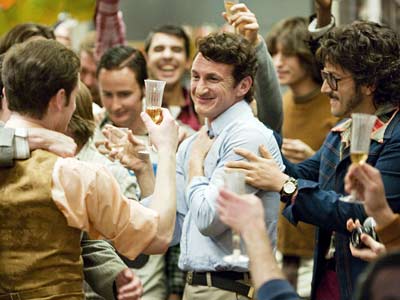
Harvey Milk was the first openly gay man elected to public office. The word "openly" is key to the film and Harvey's story. Living a closeted life as an insurance man in New York City, Harvey's world is changed after an encounter with Scott Smith (James Franco). Milk's relationship with the man is galvanizing and, with Scott's encouragement, the two move out to San Francisco's Castro Street where Harvey begins to live more openly and soon becomes a civil rights activist. He transforms Castro Street, San Francisco, and impacts the nation. Milk's key message, and one that will continue to resonate with modern audiences, is that by living openly more people will come to know gay men and women. Once knowing their friends, relatives, and neighbors are gay, they will be more apt to support civil rights for them.

Director Gus Van Sant establishes an electric atmosphere in the early going of Milk moving the film along at a brisk pace. For the director of the recent languid Paranoid Park and Last Days, this is quite startling. There is a real urgency to the film in both subject matter--in light of California's recent Prop 8 voting--and tone. The film cuts masterfully between actual documentary footage and staged material while Harvey Milk (Sean Penn) narrates his own life. Through the use of narration, Van Sant and screenwriter Dustin Lance Black are able to compress large chunks of history into the two hour running time. But this compression also gives the characters short shrift as we lose out on watching their evolution due to the need for exposition. Such are the perils of the biopic.

But the film is nonetheless engrossing. Sean Penn melts into the role and is surrounded by strong supporting players including Emile Hirsch, Diego Luna, Alison Pill, and Joseph Cross. Josh Brolin, in the midst of a career renaissance, delivers an exceptional performance as a troubled politician. It was also nice to see High School Musical co-star Lucas Grabeel moving beyond the peppy Disney franchise and giving a small, but convincing performance. The film attempts to cover a great deal in two hours and its ambition ultimately undermines its dramatic impact. Nonetheless the film is solidly crafted, expertly acted, and it tells a story still very relevant.

Tuesday, December 30, 2008


Doubt (Dir: John Patrick Shanley)

The cast of Doubt is tremendous, accomplished. The film, adapted from a stage play, deals with big themes like the nature of truth, sexual identity, and the still relevant theme of abuse of power within the church. With its question of whether or not a priest is abusing his position of headmaster of a middle school, the movie has infinite dramatic potential. But the movie is also heavy handed and underlines its themes repeatedly, over emphasizing its core questions so those in the cheap seats don't miss them. The film is indeed about Doubt. And Sin. And Guilt. And just in case you missed it, the movie repeats the word "doubt" at several crucial points throughout.

See this is a movie about Doubt and each character struggles with doubt and the dramatic climax arrives when several characters finally confront their own doubts. And perhaps I would be more willing to forgive the film its heavy hand if the final exchange did not ring so false and end with yet another repetition of the word doubt. Meryl Streep delivers these final lines and it seems without this final thematic overkill, the film might have arrived at a more satisfying conclusion.

Doubt falls apart in the final moments and reveals what a machine the entire enterprise actually was. The central story is merely a means to give actors a chance to have important, heated conversations about meaty themes. Doubt, the film at least, is about the actors. They all do an excellent job, but in the end it all feels like an exercise. The film is also an exercise in ambiguity: did or didn't he. In the end, who cares, because there is no answer.

See the title.

Sunday, December 28, 2008


The Curious Case of Benjamin Button (Dir: David Fincher)

Button is a movie that takes its time. It tells three different tales--the story of the titular hero who ages in reverse (Brad Pitt), an introductory yarn about a very special clock, and the framing tale of a daughter preparing to say goodbye to her elderly, dying mother (Cate Blanchett). That the stories are all connected should be no surprise, but what is surprising is how much time Fincher is given to weave his tale. This is a big, intimate epic. It's a sprawling movie that sets out to tell a life and grapple with mortality. The special effects are dazzling, but I was more astounded by the storytelling chutzpah. The director is working with a huge canvas.

David Fincher will fare very well in future critical surveys of his work. He has already made a perfect film in Zodiac and other than the serviceable Panic Room, his films are consistently ambitious, visually assured, and gripping. Button, however, is the first film he's made that will get the awards folks to take serious notice and likely find broad appeal among women. (His previous works also include Seven, The Game, and Fight Club.)

The film uses its special effects well and they strengthen the story as opposed to overwhelm it. Seeing Pitt as both an infant senior citizen and an elderly teen is fascinating, but it serves the story. (And seeing Brad Pitt look as young as he did in The River Runs Through It is mind boggling.) The film will be compared to Forrest Gump, both of which were written by the same screenwriter, but Gump frequently seemed to be about its special effects. In Button the make-up and computerized effects blend more seamlessly and accentuate the story. The logistics of the reverse aging will also please the sci-fi and fantasy geeks in the audience.

But the aging is a device used to tell a story about longing, regret, and trying to hold on to others in spite of the inevitable. It's a necessarily sad tale, but it also heartens the audience and gives us appreciation for our loved ones and own lives. And for that it's a movie to be cherished and admired.

Friday, December 26, 2008


Kabluey (Dir: Scott Pendergast)

Nearly drowning in indie quirk, Kabluey manages to pull its head above water for a touching conclusion. This film takes place in indie land where nearly everyone and everything is quirky. The cars are quirky, the grocery store is quirky, and the clerks are all quirky. Northern Exposure and Wes Anderson succeed in their quirkified excesses by also creating characters that are deeply flawed and very human. When Kabluey strips away the quirks, humans emerge and the story moves the viewer.

The story opens with Leslie (Lisa Kudrow) hiding in the closet from her two menacing children and speaking with her mother-in-law about how overwhelming her life has become since her husband left for Iraq. Enter lovable loser and brother-in-law Salman. He shows up in part to help out around the house and in part because he has nowhere else to go. In order to help with bills Salman takes the job of a giant blue company mascot. The mascot suit proves a fantastic comic device and makes for excellent visuals and funny physical gags.

As Salman settles in to his new life, he discovers myriad problems. Lisa's life is out of control and the internet start-up for which he is working is on the brink of collapse. Though he has always been a doormat and failure, Salman finds himself in a situation that demands he act. The suit, Salman discovers, evokes very strong reactions in others and he must decide how to use this new power. Can he finally take control of his life and become an actor not merely the acted upon?

As mentioned, in the film's final moments, the movie strips away the quirkiness and closes well. The final scenes feature people merely talking to one another, finally confronting the mess they have made of their lives and trying to face the future. Kabluey is hit and miss, but it achieves a special grace in its closing.

Tuesday, December 23, 2008


Redbelt (Dir: David Mamet)

Director and playwright David Mamet has earned his critical cred by creating works such as the blistering actor's showcase Glengarry Glen Ross and densely plotted films like the comedy State and Main. He is a master of plotting. Moving his characters like chess pieces, toying with the viewer, creating worlds of treachery and conspiracy. His movies are games that tease and toy with the audience. He is also a master of dialogue more interested in capturing the disjointed non sequitur filled way people actually speak than with conveying exposition.

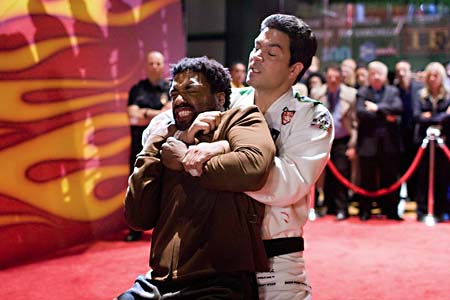
For his latest effort he lends his talents to the kind of film usually populated by the likes of late night cable staple Don "The Dragon" Wilson. Redbelt tells the story of jiu-jitsu teacher Mike Terry (Chiwetel Ejiofor) and his efforts to remain true to his principles. Terry is very good at what he does and has gained notoriety among Los Angeles fight promoters, but refuses to enter into the glitzy world of televised mixed martial arts bouts. He desires to pass along his knowledge to those in need of it, but avoid fighting for show.

But Terry is in a Mamet film where everyone conspires against you and draws you toward inevitable confrontation. From the very first moments, the film creates unease in the viewer and moves with urgency. Fighters grapple, a gun appears, and a sudden violent act occurs that sets the whole film in motion. The principled hero will be forced into an impossible situation and his belief that every trap can be escaped will be tested.

The film is perhaps too enslaved to genre conventions and it reveals this in the final third as it enters the more melodramatic world of the impossible fight against the evil villains. Still this is certainly one of the best fight films I have ever seen and Mamet's plotting, as always, amazes. The film does not desire more than to tell an entertaining story well and at that it succeeds.

Monday, December 22, 2008


Happy-Go-Lucky (Dir: Mike Leigh)

Poppy is a perpetual optimist out to brighten the lives of all around her. Her optimism, however, does not cheer all, irritating bookish store clerks and angry driving instructors. Is Poppy's joy pathological? Is she broken and in need of fixing? Is she stuck or exactly where she wants to be?

Poppy (Sally Hawikins) is a fascinating character in one of the year's best films. Director Mike Leigh has fashioned, in his usual manner, a character study more concerned with conversation and the nuance of human interaction than plotting. You may find yourself impatient for the first twenty minutes or so tapping your feet and asking where's the plot and who is this crazy lady. But when Poppy leaves her circle of club hopping pals and meets her foil, the deadly serious driving instructor Scott (Eddie Marsan), the film takes off. As the two clash--Poppy with her loud dress and barrage of silliness and Scott with his barely contained rage--Poppy's character sharpens.

Poppy at first appears oblivious to the pain of others, but we begin to learn the method to her seeming madness. She desires to heal the broken and we see her give fully of her spirit to the broken and hurt. A more quiet individual, a man who also helps those in need, spots Poppy and finds a kindred spirit. He notices her healing grace almost immediately.

This is not a heavily plotted film. It is largely a collection of scenes in which personalities collide. The final exchanges between Poppy and Scott are highly engrossing and it is in these moments that we realize how deeply we have come to care about Poppy's world and all the flawed individuals in it. Leigh has created a film full of grace and forgiveness in which flaws are observed more than chastised. He wants us to know his characters not judge them. It's a lovely movie and is the rare film that nourishes the spirit. I am happy I met Poppy and look forward to returning to her world.

Saturday, December 20, 2008


Slumdog Millionaire (Dir: Danny Boyle)

Sex. Love. Death. Fame. Violence. Slumdog tells an epic story of greed, love, and redemption in under two hours. With an impressionistic style and economic storytelling, director Danny Boyle has crafted a thoroughly romantic tale of treachery and longing. It's a Movie filled with larger than life Villains and a from the slums Hero trying to secure the treasure, win the princess, and vanquish the dragon. But it's also merely serviceable. A way to pass the time.

While I didn't dislike the film, I think it falls short of the transcendence it wants to achieve. Boyle wants to create an old school love story with over-sized emotions that sweeps you up and leaves you high on its Movie Majesty and celebration of Love. (See also Baz Luhrmann.) Instead, I was left admiring Boyle's editing as the characters are too thin to leave an impression. Also, the motivations of the film's on again off again villain turn on a dime and wholly serve the script rendering him more a device than person. The movie will give you back what you put into it. An impression of transcendence will have to be supplied by the viewer because the filmmaker is too concerned with crafting a whizz bang movie machine.

The film's first fifteen minutes or so are its most gripping. Slum dweller Jamal and his friends play cricket on a nearby airfield and are soon chased away angrily by club wielding cops on scooters. The flight of the slumdogs takes them across the roofs of a Mumbai slum while the screaming police pursue. It's a great, alive scene that gives us an immediate sense of place, poverty, and oppression. Jamal will soon meet the Girl who will become his Quest and repeatedly be hindered by his avaricious brother.

Slumdog consistently displays a dynamic visual sense, but leaves much to be desired in the storytelling department. Cynical? Maybe, but the characters are too thin and too motivated by the needs of script to move this viewer.